Good marketing
starts with solving
the right problem.
Sometimes it's positioning. Sometimes it's pipeline. Sometimes it's realizing the problem isn't marketing at all. I've spent my career figuring out the difference.
ARR scaled, from first revenue to enterprise
- Rapid7
- Insight Venture Partners
- Dari Motion
Marketo — early adopter of marketing automation
Case Studies
- The problem
Cybersecurity platform with $250K+ ACV in a crowded MDR market with long, trust-driven sales cycles. When I joined in fall 2022, BlueVoyant had a 30-person marketing org and $9M in annual spend, concentrated in large brand events, sponsored regional events and paid demand generation.
- — Pipeline volume looked strong, but deal conversion and progression were weak.
- — Differentiation was inconsistent across sales, with no clear, repeatable “why BlueVoyant.”
- — Cost per sales-qualified meeting sat around $10K (2021–H1 2022), forcing a strategic reset.
The thinking- Channel reset. Eliminated large brand events, cut sponsored regional programs to a few targeted bets, and moved non-converting paid digital into hosted physical and virtual events where we controlled audience quality.
- Brand & credibility. Invested in PR and analyst relations for sustained visibility with Gartner and top-tier publications. Buyers already knew BlueVoyant before the first call.
- Positioning & enablement. Rebuilt the core pitch around a clear platform story and rewrote MDR positioning so every rep could articulate the difference.
- Platform & expansion. Led the launch of the BlueVoyant Security Operations Platform, unifying MDR, SCD and DRP. Drove bundling, cross-sell strategy and enablement.
The outcome- Annual marketing spend reduced from $9M to $3.5M while holding 25% contribution to total ARR.
- Marketing headcount reduced by 50%.
- Improved deal quality, narrative consistency and expansion readiness across sales.
- Grew one of the category's largest organic LinkedIn audiences: 15,000 → 110,000.
- The problem
Digital Risk Protection platform selling into enterprise security teams. The GTM engine was generating pipeline and reaching the right buyers, but struggling to convert through proof-of-concept.
- — Demand generation worked — deals consistently reached POC.
- — Late-stage losses clustered in the most mature enterprise segment, where buyers favored the incumbent.
- — Differentiation struggled at the top end of the market.
The thinking- Positioning & ICP reset. Customer interviews and firmographic funnel analysis showed where deals failed. Moved away from mature threat-intel teams toward SOC-led organizations without dedicated TI, where ease of deployment won.
- Signal-driven targeting. Piped product API data into Salesforce to flag accounts with known, active threats — combining firmographics with real risk signal to tier outbound.
- GTM scale. With ICP clarified, scaled demand gen and outbound into direct mail, hosted regional events and targeted physical and virtual experiences.
The outcome- Marketing consistently drove 50% of total ARR.
- Scaled from $7M to $27M ARR.
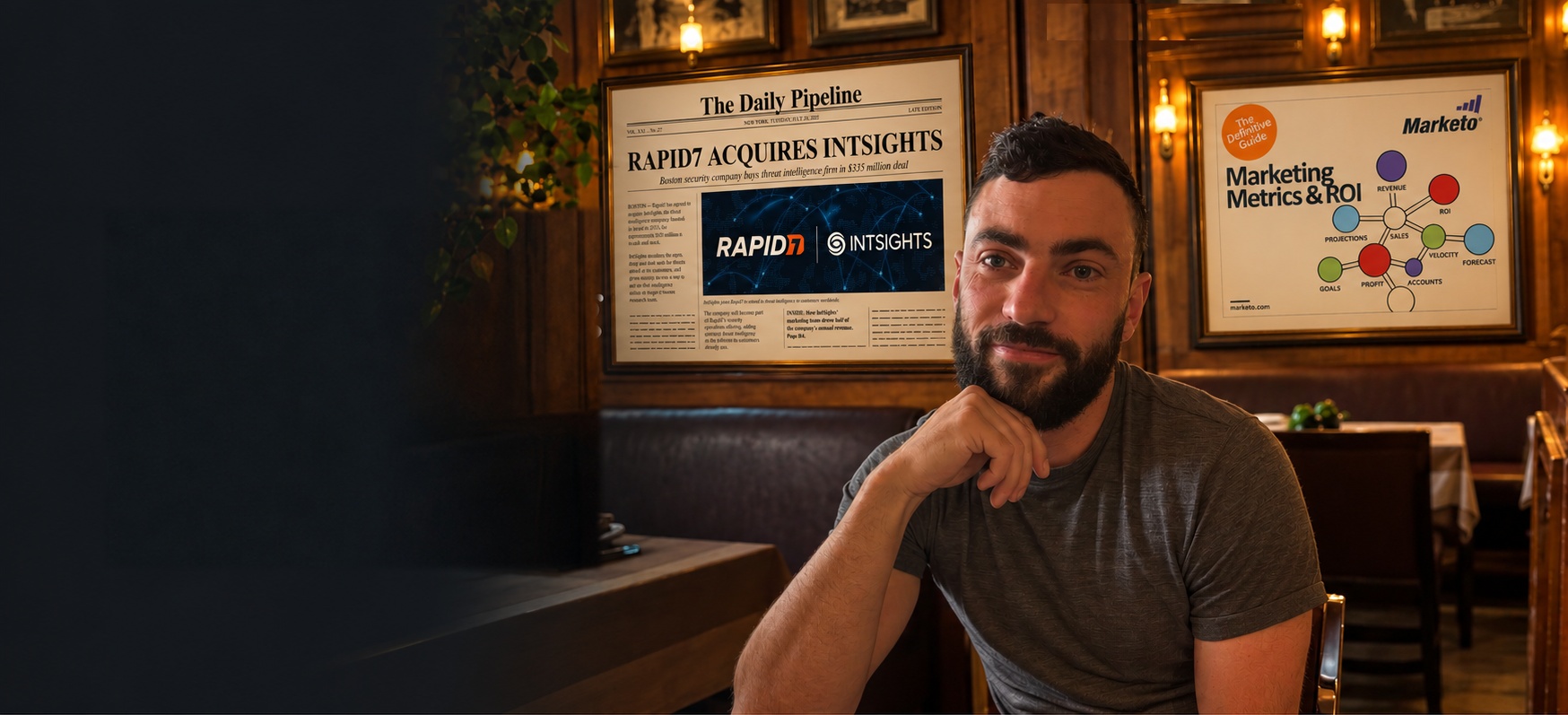
- Supported the acquisition by Rapid7.
- The problem
Hired with three concurrent mandates: implement Marketo, rebuild the brand and website, and build demand gen. The category tailwind was real — the gap was infrastructure and speed, not narrative.
- — No marketing automation or routing; reps triaged leads in spreadsheets, often days late.
- — Dated brand and website with no differentiated identity.
- — No scalable way to turn growing inbound interest into fast, personalized follow-up.
The thinking- Automated pipeline engine. Connected Marketo → Salesforce → LeanData → MadKudu → Salesloft. A whitepaper download became a rep-ready, personalized cadence in under 30 seconds with zero manual triage.
- Event speed. List uploads triggered personalized outreach the same night or next morning, while competitors were still emailing spreadsheets.
- Brand relaunch. Shipped a new identity and website in three months — winning a Hermes Award.
- Program scale. Scaled inbound, field and demand programs on top of the engine, including a 100+ event/year field program.
The outcome- Marketing-sourced opps grew from ~20–30/month to a peak of ~150–170/month.
- Marketing-sourced pipeline grew from ~$2M/quarter to ~$7M in Q2 2018.
- Field program drove 30% of total pipeline.
- Pipeline 4x, inbound MQLs 3x.
- The problem
The #1 board management platform had reached $50M ARR without ever sending a marketing email. A new McKinsey-alumni CEO and CMO set out to professionalize GTM ahead of a PE transaction; I joined to build measurement and demand gen from zero.
- — No tracking, measurement or digital infrastructure at the category leader.
- — The buyer — a Board Secretary — was a narrow, low-search persona; digital alone had a ceiling.
- — Growth had never been intentionally engineered.
The thinking- Measurement first. Implemented Marketo and built Diligent's first tracking, measurement and digital demand gen function.
- Recognized the ceiling. Made the data-backed case that digital couldn't hit targets alone, and won approval to build outbound.
- Built the SDR engine. Implemented Salesloft and hired the SDR team from zero; each rep booked 15 meetings a month.
The outcome- Scaled from $50M to $150M ARR.
- First digital, measurement and SDR infrastructure, built from scratch.
- 15 meetings per rep per month, consistently.
- Contributed to the acquisition by Insight Venture Partners.
- The problem
First senior marketing hire, arriving during layoffs at a Foundry Group-backed company that had never exceeded $1M ARR. Leadership saw the market as generic “motion capture.”
- — Fidelity trailed marker-based systems — “replacement” was a losing argument.
- — Only one commercial customer (WB Montreal) and no proof the model could scale.
- — No evidence-based view of who actually needed the product, or why.
The thinking- Found the real use case. WB Montreal's Animation Director used it for previs and as a guide for hand-animation. The repositioning: not a replacement for marker systems, but a way to cut time and cost inside them.
- Built proof and went direct. Hired him as a consultant, built a case study, and ran a handwritten direct-mail campaign to 50 game studios.
- Owned the motion. Ran all 30+ resulting demos personally — landing Disney and Ubisoft.
- Opened a second market. Rebuilt the site to rank #1–2 for motion capture, unlocking university animation programs.
The outcome- Scaled from $1M to $4M ARR, doubling revenue two years straight.
- Landed Disney and Ubisoft from a 50-studio campaign.
- Opened education as a second growth channel.
- Contributed to the acquisition by Dari Motion.